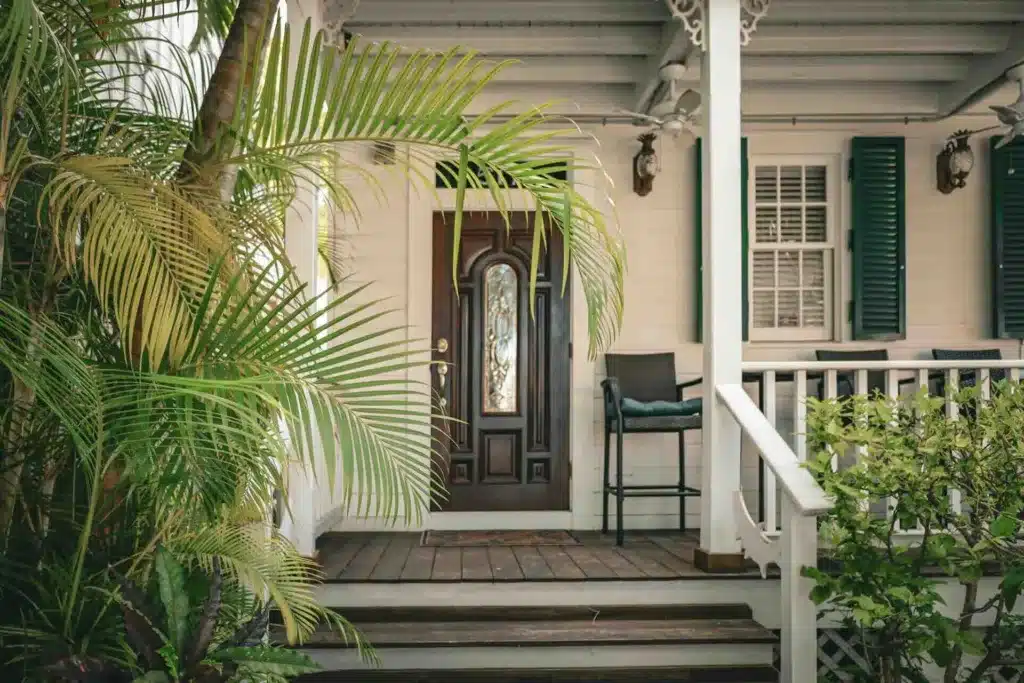

The most common types of entry doors for Florida Keys homes are single doors, double doors, single-with-sidelights, French doors, full-light and half-light glass doors, Dutch doors, and pivot doors, each available in impact-rated configurations that meet Monroe County’s hurricane wind-load requirements.
That’s the short version. Below’s the longer one, with the trade-offs that actually matter when salt air, hurricane season, and the Florida Building Code all sit at the same table.
Key Takeaways
- The main types of entry doors are single, double, sidelight, French, glass-light, Dutch, and pivot configurations
- Every type can be specified as impact-rated for Florida Keys exposure
- Door style (the type) and door material (fiberglass, steel, wood, aluminum) are two separate decisions, and both both matter
- Monroe County enforces wind-borne debris protection that effectively makes impact-rated assemblies the default
- Glass area drives both curb appeal and solar heat gain; bigger glass means higher cooling costs
- Hardware, threshold, and weatherstripping fail before the slab does
- ENERGY STAR ratings for the Southern climate zone help control AC bills
- The licensed, insured contractor doing the install matters as much as the door itself
Why Door Type Matters More in the Keys
Pick the wrong front door style up north, and you’ve a draft. Pick the wrong one in Key West and you can lose the door, the frame, and the wall behind it.
The Florida Keys sit at the meeting point of three brutal forces: relentless ultraviolet (UV) radiation, year-round salt-laden humidity, and direct hurricane exposure. The Florida Building Code recognizes this.
While the strict High-Velocity Hurricane Zone (HVHZ) designation officially covers only Miami-Dade and Broward counties, Monroe County enforces wind-borne debris protection requirements that align with HVHZ-level performance for most exterior openings.
That’s why the type of entry door you choose isn’t just a curb-appeal decision. It determines how the assembly performs under storm pressure, how it ages in salt air, and how much it costs to cool the rooms behind it.
8 Types of Entry Doors that Work for Florida Keys Homes
The door configurations below are the ones homeowners across Islamorada, Key Largo, Key West, and Marathon most often choose, along with what each one does best.
1. Single Entry Door
The standard configuration consists of a single door panel set in one frame and swung on three hinges. It usually measures about 36 inches wide and 80 inches tall, which remains the most common size in residential construction.
It’s best suited for:
- Most of Florida Keys homes, especially smaller cottages and bungalows
- Tight entry spaces with limited wall around the opening
- Budget-conscious replacements
Trade-offs: less dramatic curb appeal than double or sidelight configurations, and harder to move large furniture through. For a typical Conch-style cottage in Old Town Key West or a single-family in Marathon, a well-specified single impact-rated door is often the right call.
2. Single Door with Sidelights
This configuration pairs a single operable door with one or two sidelights, narrow vertical glass panels, on either side. The door itself opens and closes normally while the sidelights stay fixed in place.
This type of door’s a strong fit for:
- Homes with wide entry walls that would otherwise look bare
- Owners who want more natural light without giving up impact protection
- Most midrange and upper-midrange Keys homes
Trade-offs: sidelight glass adds cost and increases solar heat gain. Specify laminated impact glass on every panel, sidelights included, or the assembly’s hurricane rating goes out the window with the first piece of debris.
3. Double Entry Doors (French-Pattern Entry)
Double entry doors feature two full-size door panels that meet at the center, typically with one active leaf that opens and one inactive leaf that stays closed unless needed. The total opening usually runs 60 to 72 inches wide.
These doors work well for:
- Larger homes in Islamorada and Marathon, especially waterfront estates
- Grand entries on Conch Key, Duck Key, and Ocean Reef properties
- Homes where the architecture calls for visual symmetry and statement curb appeal
Trade-offs: more expensive, requires a structurally sound jamb and proper anchoring at twice the contact points, and the inactive leaf needs flush bolts top and bottom for storm performance. Done right, these doors are the most impressive entry type. But if done wrong, this type of entry door’s the most failure-prone.
4. French Entry Doors
True French doors consist of a pair of doors with full or near-full glass panels, and both leaves are typically operable. They differ from double entry doors, which usually have solid panels or only partial glass.
This type of door’s often chosen for:
- Homes opening onto a covered porch or veranda
- Period-appropriate look for some historic Key West properties
- Owners prioritizing light and indoor-outdoor flow over thermal performance
Trade-offs: the highest solar heat gain of any entry type because of the glass area, and the most expensive to specify in impact-rated form. ENERGY STAR’s Southern-zone SHGC limits matter here more than anywhere else. If you want the same indoor-outdoor flow without using your front entry, patio doors or sliding patio doors are often a better fit for the back of the home.
5. Full-Light Entry Doors
Sometimes called “full glass” or “full vision” doors, a full-light door’s a single panel with glass covering 75 to 100 percent of its surface.
This type of door’s a natural fit for:
- Modern coastal architecture, especially newer canal-front homes in Key Largo and Islamorada
- Owners who prioritize daylight in the entry foyer
- Minimalist design palettes
Trade-offs: highest solar heat gain on a single door. Privacy’s also lower unless you specify obscured, frosted, or textured glass. All glass must be laminated impact for any meaningful storm rating.
6. Three-Quarter Light and Half-Light Doors
These doors feature glass over the upper 50 to 75 percent of the panel, with a solid wood, fiberglass, or steel section below. The split between glass and solid material gives the door its name.
This type of door’s popular with:
- The pragmatic middle ground: most light, decent privacy, lower cost than full-light
- Traditional coastal homes that want some glass without a full-vision look
- Most replacement projects across the Florida Keys
Trade-offs: fewer of them than the extremes above. This’s one of the most popular configurations for a reason; it balances light, privacy, cost, and storm performance.
7. Dutch Doors
Split horizontally across the middle, a Dutch door allows the top half to open while the bottom half stays closed. The look’s distinctively coastal and cottage-inspired.
This type of door’s most often seen on:
- Historic Key West properties and traditional Conch-style cottages
- Homes in which the owner wants ventilation without leaving the door fully open
- Niche preference more than a mainstream type
Trade-offs: harder to find in impact-rated configurations, and the horizontal seam is a weak point under storm pressure. Many manufacturers don’t offer impact-rated Dutch doors at all, which can be a deal-breaker in Monroe County.
8. Pivot Doors
Comprising oversized single panels, often 4 to 6 feet wide and 8 to 10 feet tall, pivot doors rotate on a concealed top-and-bottom spindle rather than swinging on traditional side hinges. The result is a dramatic, modern entry that moves with surprising ease for its size.
This type of door fits:
- Modern architectural builds, especially contemporary waterfront homes in Islamorada and the more modern Marathon developments
- Statement entries where scale itself is the design move
- Higher-end budgets
Trade-offs: expensive, requires structural framing modification, and sourcing impact-rated pivot systems is a specialist job. When it works, it’s spectacular. The price-to-performance gap, however, is the largest of any door type on this list.
Beyond Type: Door Material Decision
The type of entry door’s the shape and configuration, and the material’s what it’s made of. These are two separate decisions, and you’ll need to make both.
In Florida Keys conditions, door materials tend to perform as follows:
- Fiberglass—Practical winner for most homes, fiberglass doors don’t warp, rot, swell, or rust and convincingly mimic wood grain. Available impact-rated from PGT, ProVia, Therma-Tru, and similar Florida-focused manufacturers. Low maintenance.
- Steel—Best price for impact-rated security, steel doors are dense, hard to breach, and built around a galvanized core that delivers solid thermal performance when foam-filled. Watch for rust at coastal exposures; pair with stainless hardware and inspect annually.
- Solid wood—Beautiful for historic Conch homes. Demands consistent refinishing every two to four years against UV and salt humidity. Mahogany, teak, and ipe handle the marine environment best.
- Marine-grade aluminum—Outstanding salt-air resistance and the only material that practically supports very large glass panels and pivot configurations.
Any door type from the list above can be specified in any of these materials, with availability dropping as you move toward niche types (for instance, Dutch in fiberglass is easy, but Dutch in marine-grade aluminum’s rare).
What the Florida Code Requires for Any of These Door Types
Whichever type of entry door you choose, the baseline requirements stay the same. For homes in Monroe County, your replacement entry door generally needs:
- Valid Florida Product Approval (FPA) or Miami-Dade Notice of Acceptance (NOA), with the approval covering the specific size, glass type, hardware, and anchoring you’re installing
- Design Pressure (DP) rating matched to your site’s wind-load requirements (often DP 50 or higher for Keys properties)
- Impact resistance: either a fully impact-rated assembly or a nonimpact door protected by an approved shutter system
- Permit from your local Monroe County or municipal building department plus inspection
- Installation by a Florida-licensed contractor who carries the required general liability and workers’ compensation insurance
The DP rating applies to the entire assembly: frame, slab, hardware, glass, weatherstripping, tested as one unit. Swapping in a different deadbolt or off-spec glass insert can void the rating, which is why mixed-and-matched do-it-yourself (DIY) door projects fail inspections.
References worth bookmarking: the Florida Building Code (administered by the Florida Building Commission), the Federal Alliance for Safe Homes (FLASH) for plain-language wind protection guidance, and the Insurance Institute for Business & Home Safety (IBHS) for independent testing data on storm-rated openings.
What Else Decides How Long Any Type Lasts
Homeowners obsess over the door type; installers obsess over everything else because that’s what fails first.
Hardware
The metal that holds the door together’s the first thing salt air attacks so component quality matters as much as the door itself.
- Stainless steel or marine-grade brass hinges; anything less corrodes within a few seasons
- Multipoint locking systems improve both security and storm performance
- Smart locks are fine, but verify that they’re rated for high-humidity environments
Glass Inserts
Decorative glass panels are a beautiful upgrade, but they need to be specified carefully to maintain storm performance.
- Any decorative glass in a Florida Keys entry door should be laminated impact glass, not standard tempered
- Larger glass areas mean more solar heat gain so check the SHGC rating
Threshold and Weatherstripping
These small components do the unsung work of sealing your entry against wind-driven rain and humidity.
- Adjustable thresholds let you compensate for floor settling
- Compression weatherstripping outperforms standard rubber gaskets in storm conditions
- Inspect annually; replace when compressed or torn
Frame and Anchoring
How the door connects to the wall’s what actually determines whether it holds up in a storm.
- Pressure-treated jambs resist termite damage and moisture
- Proper anchoring per the manufacturer’s installation instructions is what gives the door its rated DP; improperly anchored doors fail at a fraction of their rating, regardless of slab quality
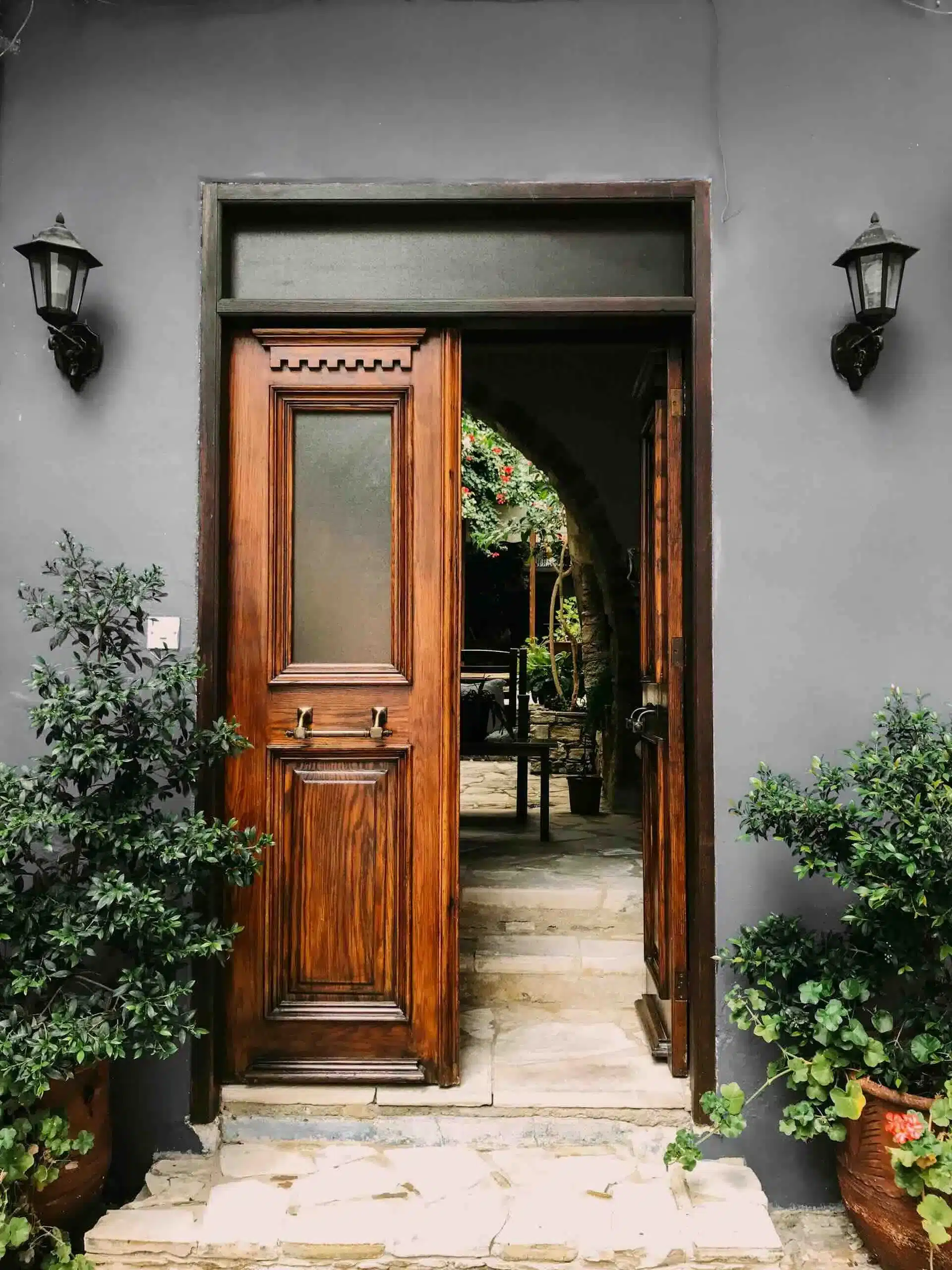
Impact-rated doors provide security and storm protection while improving insulation. Professional installation ensures proper sealing and performance, which is critical in our wind-driven rain environment.
ENERGY STAR and the Southern Climate Zone
The Florida Keys are in the ENERGY STAR Southern climate zone, which prioritizes blocking solar heat over retaining indoor heat. For a certified ENERGY STAR exterior door in the Southern zone, the targets are:
- U-factor—at or below 0.28 to 0.32 depending on glazing level (lower’s better)
- Solar Heat Gain Coefficient (SHGC)—at or below 0.23 (lower’s better in our climate)
- Air leakage—at or below 0.5 cfm/ft²
This matters most on the high-glass types: French, full-light, and three-quarter-light doors, where SHGC drives real cooling cost. ENERGY STAR-certified doors can also qualify for the federal Energy Efficient Home Improvement Credit, administered through the U.S. Department of Energy and the IRS.
How Pricing Compares by Type
The numbers below offer a working range for impact-rated entry door projects in the Florida Keys when fully installed.
- Single entry door, fiberglass standard: around $2,500-5,000
- Single door with sidelights: around $4,000-8,000
- Double entry door (fiberglass): around $5,000-10,000
- French entry door: around $5,000-12,000
- Full-light or three-quarter-light door: around $3,500-9,000
- Dutch door: around $4,000-10,000+ (limited impact-rated availability)
- Pivot door: around $10,000-25,000+
- Solid wood custom door (any type): typically $5,000-15,000+ before pivot
Permitting and engineering for HVHZ-equivalent openings can add several hundred to a couple thousand dollars depending on scope. These are general industry ranges; actual project pricing requires an on-site assessment.
Choosing the Right Contractor: Five Nonnegotiables
The door is only as good as the install. Before signing a contract, confirm:
- Active Florida contractor’s license—Verify through the Florida Department of Business and Professional Regulation (DBPR) license search
- General liability and workers’ compensation insurance—Current, with certificates available on request
- Familiarity with Monroe County permitting—It isn’t optional knowledge in the Keys
- Manufacturer authorization for the brands they install (PGT, ProVia, Simonton, Therma-Tru, Andersen, Neuma)—This protects your warranty
- Written scope that names the exact product, FPA or NOA number, DP rating, and door installation specs
Reputable local contractors should also share Better Business Bureau standing and recent customer references in your specific Keys community.
Which Type Tends to Fit Where Across the Islands
As you conduct your postholiday inspection, document everything. The Florida Keys insurance market is complex, and proper documentation can make the difference between claim approval and denial.
- Key Largo—Single and single-with-sidelight doors dominate; full-light doors are typical in newer canal-front builds
- Islamorada—Single-with-sidelight and double entry doors are common in waterfront estates; pivot doors are often chosen for modern architectural builds
- Key West—Single doors dominate in older neighborhoods; double entry doors on larger lots; mid-range across the spectrum
- Marathon—Single doors dominate in older neighborhoods while double entry doors appear on larger lots so most installations are in the midrange on both price and style
Reference Sources:
- ENERGY STAR®: Residential Windows, Doors, & Skylights
- Legal Clarity: Residential Exterior Door Code Requirements in Florida
- International Code Council (ICC): Digital Codes: 2023 Florida Building Code, Residential, Eighth Edition
Frequently Asked Questions (FAQ) about the Best Types of Entry Doors in the Florida Keys
Here are questions Florida Keys homeowners commonly ask when comparing types of entry doors.
What’s the most popular type of entry door in the Florida Keys?
Single-slab fiberglass doors, often with sidelights. They balance impact protection, salt-air durability, and cost better than any other configuration for the typical Keys home.
Are double entry doors a problem in hurricanes?
Not when properly specified. Impact-rated double doors with active and inactive leaves, full flush bolts on the inactive leaf, and properly anchored frames pass Monroe County requirements without trouble. The risk’s poor specification or installation, not the type itself.
Can French doors actually work as a front entry in the Keys?
Yes, in impact-rated configurations. Plan for higher cooling costs because of the glass area, prioritize a low SHGC rating, and budget more than you would for a comparable solid-panel double door.
Do all of these types come in impact-rated versions?
Replace windows if they’re over 20 years old, won’t open or close properly, show seal failure (condensation between panes), or aren’t impact-rated. Repair makes sense for minor issues like broken hardware or damaged screens. In the Keys, the insurance benefits and storm protection of modern impact windows often justify replacement even when repair is technically possible.
Does door type affect insurance discounts?
What matters for wind-mitigation credits is whether the assembly’s code-approved and impact-rated, not which type it is. Discounts and eligibility vary by carrier so ask your insurance professional for current details.
Can I install any of these types myself?
Technically possible, practically inadvisable. DIY installation typically voids manufacturer warranties, often fails Monroe County inspection, and can void the door’s tested DP rating. Florida law requires a licensed contractor for most door replacement work involving structural openings.
How long does each type last in the Keys?
A properly installed fiberglass or aluminum door of any type typically lasts 20-30 years with basic maintenance. Steel runs 15-25 years depending on exposure. Solid wood can last 30+ years with consistent refinishing. The type matters far less than the material and the install.
Choosing the Right Entry Door for Your Home
The right type of entry door for a Florida Keys home is whichever one matches three things at once: how you want the architecture to look, how much glass and light you want at the entry, and how the assembly performs against salt and storm.
Single doors handle most homes. Sidelights add light without giving up much. Double and French doors deliver presence on larger properties. Full-light and pivot configurations make a statement when the architecture earns it. Every type can be specified to meet code; what changes are the prices and trade-offs.
Having installed doors across the Keys since 1949, we know what works on the islands and what doesn’t: from the doors that hold up best in salt air to the permitting steps Monroe County requires. That experience has earned us an A+ rating from the Better Business Bureau (BBB) and the trust of generations of Keys homeowners.
Request a free estimate when you’re ready to look at entry door options, and we’ll come to your home, take measurements, discuss your preferences, which type fits your home, your budget, and Monroe County’s requirements, and give you a fair quote.